Alzheimer Disease & the APO E4 gene
Introduction
Alzheimer Disease is a type of dementia that causes memory loss, affects thinking, and causes changes in behavior. It is a progressive, irreversible disease that has no treatment or cure. Research is still being done to try and determine the cause of AD. Apolipoprotein E (ApoE) is involved in the binding, internalization, and catabolism of lipoprotein particles. The three common isoforms of ApoE, are termed E2, E3, and E4. It is known that individuals that have at least one allele of the Apolipoprotein E4 isoform have an increased risk of obtaining AD. Having two Apo E4 alleles further increases this risk factor. It is important to note that people with the Apo E4 allele inherit an “increased risk” of developing Alzheimer disease, not the disease itself. The exact mechanism as to why that is, is not fully determined.
Procedure
An ApoE haplotype-specific sequence-specific primer (SSP)-PCR methodology identifies in three PCR reactions the allelic haplotypes that determine the three main ApoE isoforms.
The sequence-specific forward and reverse primers were combined in three haplotype-detecting reaction mixtures. Primer Mix E2: primers 1 and 3, Primer Mix E3: primers 1 and 2, and Primer Mix E4: primers 2 and 4.
To ensure PCR amplification each ApoE-specific Primer Mix also contained a pair of control primers: primers 8 and 9, which verify PCR amplification in the absence of haplotype specific amplification in each PCR reaction.
10 volunteers provided DNA buccal swabs. First each sample was isolated for DNA using a DNeasy kit. Then a master PCR mix was made for each Primer mix E2, E3, and E4. A sample of DNA from each volunteer was then run in three different PCR reactions, one for each primer mix.
The parameters for the PCR were:
96°C – 1 min
96°C – 20 s
70°C – 45 s 5x
72°C – 25 s
96°C – 25 s
65°C – 50 s 21x
72°C – 30 s
96°C – 30 s
55°C – 60 s 9x
72°C – 120 s
The PCR products were then run out on three separate 2% agarose gels. One for each APO E gene.
Results & Conclusion
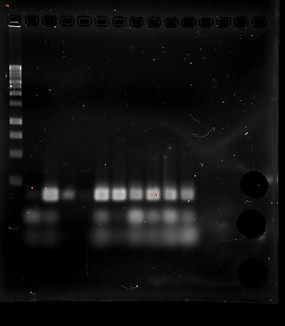
E2 Gel: E3 Gel: E4 Gel:
As seen in the pictures of the gels, gel E2 has very large bright bands that show a positive result for samples 7 and 10 having an APO E2 allele. In gel APO E3 all individuals except for sample 4 appear to have an APO E3 allele. This is the most common isoform of the three APO E alleles. In this E3 gel, individual 4 had very faint bands even for the control indicating a possible issue with this specific sample’s PCR reaction. Finally gel APO E4 had the control primers show up for every sample indicating that the PCR reaction was successful. A bright band in the 173bp region would indicate an individual being positive for having the APO E4 gene. There were no obvious bands in this region on the APO E4 gel suggesting that no individuals in this experiment have the APO E4 allele. However, many of the bands were faint indicating that the PCR parameters may need to be altered for further experiments.